 Ada-BFM
 Explore the research
One pretrained foundation. One shared adapted policy per interaction domain.
Abstract
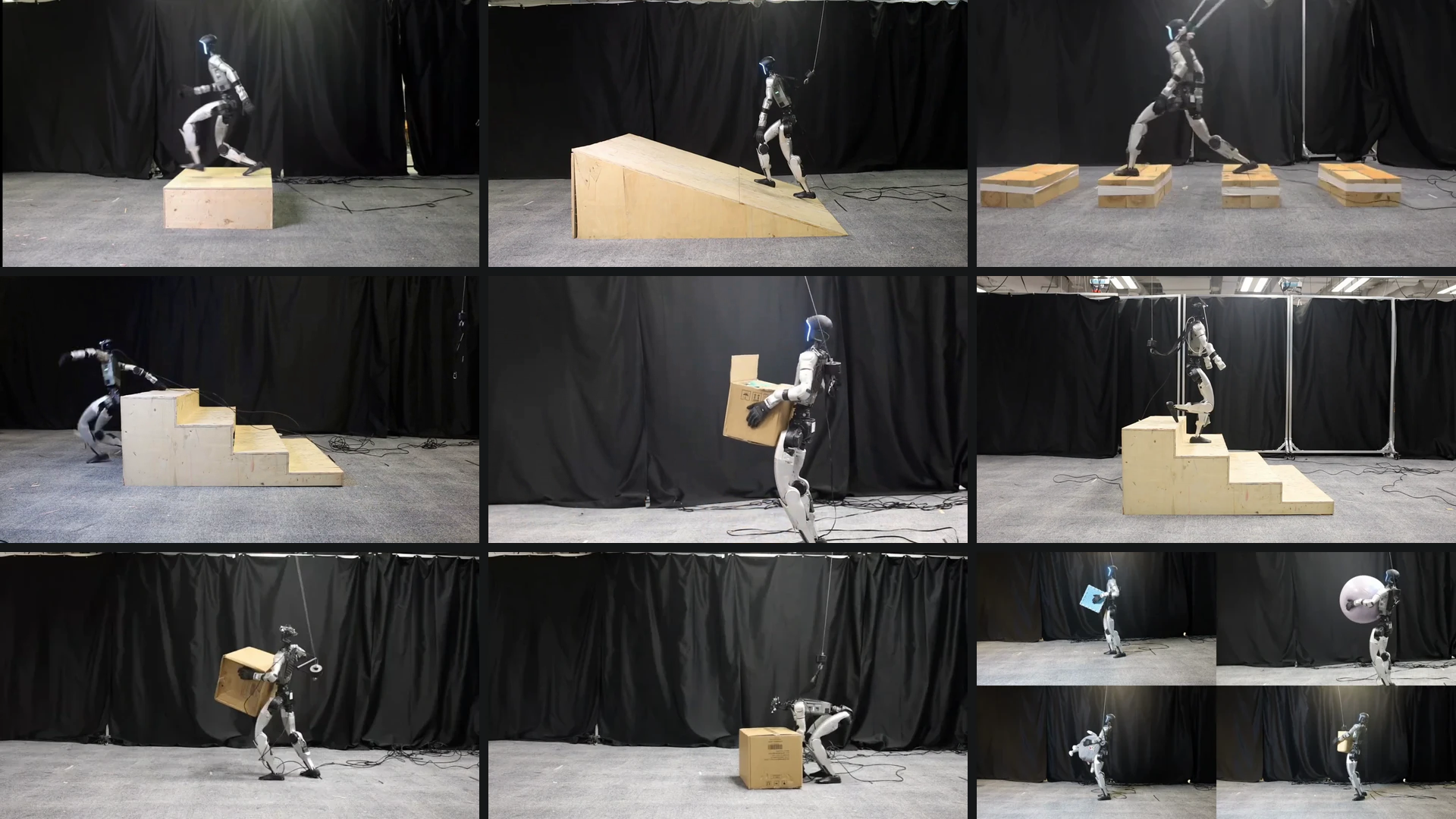
Behavior Foundation Models (BFMs) have emerged as a promising paradigm for general-purpose humanoid control through pretraining on large-scale behavioral data. However, their proficiency in whole-body coordination does not readily extend to scene interaction, which requires adapting motion to scene-dependent geometric constraints and contact dynamics. To bridge this gap, we introduce Ada-BFM, a post-training framework that adapts pretrained BFMs for humanoid scene interaction. Ada-BFM augments the original architecture with a lightweight adapter, enabling interaction-specific adjustments while leveraging pretrained control capabilities. Rather than producing a separate controller for each task, the framework yields a shared model for each interaction domain, supporting diverse tasks involving terrain or object interaction. Extensive experiments in simulation and the real world demonstrate that Ada-BFM enables diverse scene interaction behaviors, accelerates learning compared with training from scratch, and largely preserves pretrained behavioral competence. These findings establish Ada-BFM as an effective and efficient approach to extending the capabilities of BFMs beyond their pretraining settings while retaining their strengths in general whole-body control.
Terrain interaction
Object interaction
Retaining the pretrained BFM’s motion capabilities
Playback speed: 1.5× (default). Adjust the speed using the video controls.
Comparison with the pretrained BFM (without adaptation)
Method
Ada-BFM adapts a frozen behavior foundation model through lightweight, depth-conditioned adapters. A trainable depth encoder supplies scene information to gated cross-attention and feed-forward branches, enabling a shared adapted policy within each interaction domain while preserving pretrained whole-body control capabilities.
Experimental Results
Extending the capability boundary.
Ada-BFM achieves the highest success rate among the compared methods in both interaction domains.
Simulation test sets, at a 0.5 m global body-position error threshold. Object interaction additionally requires the object-tracking success criterion.
Tracking accuracy
| Method | Global position (m) ↓ | Global rotation (rad) ↓ | Local position (m) ↓ | Local rotation (rad) ↓ |
|---|---|---|---|---|
| Pretrained BFM | 0.822 | 0.940 | 0.465 | 0.810 |
| SONIC | 0.968 | 0.632 | 0.385 | 0.608 |
| PMT | 1.712 | 1.517 | 0.639 | 1.259 |
| Full fine-tuning | 0.103 | 0.203 | 0.057 | 0.201 |
| Head-only | 0.145 | 0.287 | 0.081 | 0.283 |
| LoRA | 0.060 | 0.134 | 0.036 | 0.137 |
| ViBe | 0.258 | 0.185 | 0.088 | 0.177 |
| Task token | 0.090 | 0.172 | 0.053 | 0.173 |
| Ada-BFM | 0.042 | 0.081 | 0.023 | 0.084 |
| Method | Body global position (m) ↓ | Body global rotation (rad) ↓ | Body local position (m) ↓ | Body local rotation (rad) ↓ | Object global position (m) ↓ | Object global rotation (rad) ↓ |
|---|---|---|---|---|---|---|
| Pretrained BFM | 0.135 | 0.240 | 0.069 | 0.238 | 0.564 | 1.139 |
| SONIC | 0.318 | 0.255 | 0.054 | 0.230 | 0.590 | 1.075 |
| HDMI | 0.526 | 1.045 | 0.275 | 0.954 | 0.519 | 0.914 |
| Full fine-tuning | 0.428 | 0.864 | 0.217 | 0.838 | 0.544 | 1.115 |
| Head-only | 0.260 | 0.594 | 0.125 | 0.566 | 0.547 | 1.086 |
| LoRA | 0.403 | 0.855 | 0.220 | 0.823 | 0.571 | 1.155 |
| ViBe | 0.779 | 1.291 | 0.332 | 1.236 | 0.694 | 1.227 |
| Task token | 0.121 | 0.256 | 0.064 | 0.251 | 0.448 | 1.006 |
| Ada-BFM | 0.114 | 0.297 | 0.069 | 0.290 | 0.243 | 0.745 |
Global and yaw-aligned local tracking errors; lower is better. Body-only errors do not by themselves measure interaction success.
Robustness to scene offsets
With the reference motion unchanged, Ada-BFM tolerates moderate terrain or object pose offsets. Success declines as the mismatch grows.
| Level | x/y offset (m) | z offset (m) | Yaw offset (°) | Terrain SR (%) | Object SR (%) |
|---|---|---|---|---|---|
| 0 | 0 | 0 | 0 | 99.14 | 65.75 |
| 1 | [-0.05, 0.05] | [-0.025, 0] | [-5, 5] | 98.86 | 60.38 |
| 2 | [-0.10, 0.10] | [-0.050, 0] | [-10, 10] | 96.63 | 54.85 |
| 3 | [-0.20, 0.20] | [-0.100, 0] | [-20, 20] | 86.81 | 34.36 |
Each motion is evaluated five times per level, with offsets sampled from the listed intervals. Level 0 applies no offsets.
Build on coordination already learned.
Ada-BFM learns faster and reaches higher rewards than training from scratch in both interaction domains. It also outperforms adaptation from a small pretrained BFM.
The pretrained foundation matters
A higher-capacity BFM pretrained on a more diverse motion dataset provides a stronger starting point for scene interaction.
| Method | Terrain SR (%) | Object SR (%) |
|---|---|---|
| Ada-BFM | 99.14 | 65.75 |
| Ada-BFM (small pretrained) | 78.19 | 41.64 |
| Training from scratch | 0.41 | 11.51 |
Success rates use the same domain-specific evaluation criteria as the effectiveness comparison.
Adapt without starting over.
Ada-BFM retains 94.4% BONES success after terrain adaptation and 89.3% after object adaptation, compared with 97.2% for the frozen pretrained BFM.
Ada-BFM retains more than Task token after terrain adaptation; Task token retains more after object adaptation. Consider retention alongside scene-interaction success.
| Method | After terrain adaptation (%) | After object adaptation (%) |
|---|---|---|
| Pretrained BFM (frozen reference) | 97.2 | 97.2 |
| Full fine-tuning | 73.4 | 40.8 |
| Head-only | 87.5 | 46.5 |
| LoRA | 84.9 | 35.1 |
| ViBe | 53.9 | 27.1 |
| Task token | 93.6 | 92.9 |
| Ada-BFM | 94.4 | 89.3 |
Same 10,000-clip BONES manifest, at a 0.5 m global body-position threshold. Adapted checkpoints are evaluated with their scene pathway enabled.
Which motion capabilities change?
Retention varies by motion category. Stunts and unusual locomotion show larger drops, while many everyday motion categories remain closer to the frozen reference.